
What Is a Metaphor?
A metaphor is a figure of speech that compares two different things by saying one is the other. It creates a strong image without using the words like or as.
Examples:
- “Time is a thief.”
- “Life is a journey.”
- “Hope is a light.”
A metaphor turns an abstract idea, such as a secret, into something readers can easily imagine.
What Does “Secret” Mean?
A secret is information that is intentionally kept hidden from others. It may be private, personal, surprising, or confidential.
People keep secrets to:
- Protect someone’s feelings.
- Keep a surprise.
- Stay safe.
- Respect privacy.
- Avoid sharing personal information.
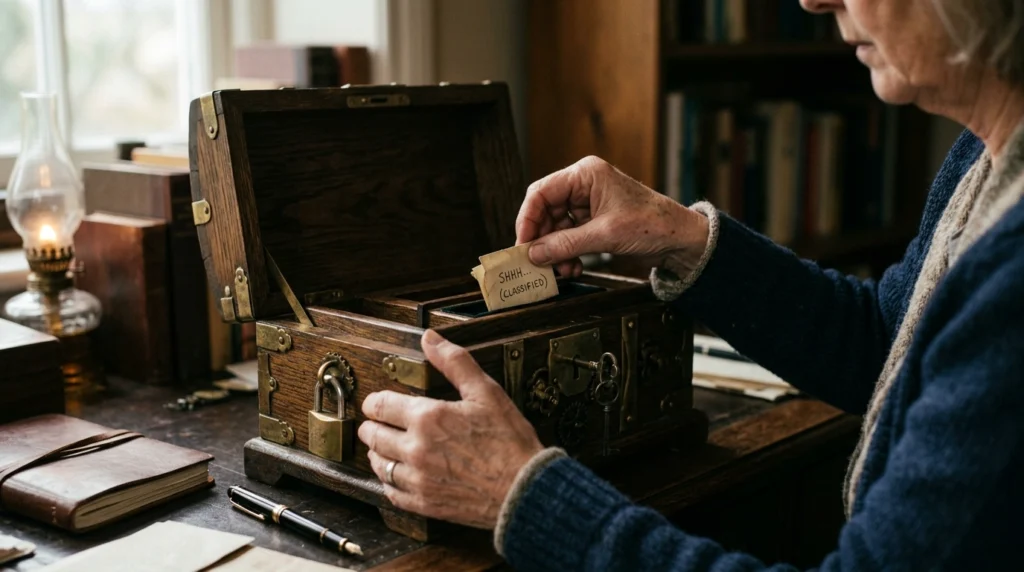
Because secrets are hidden, many metaphors use images of locks, treasure, shadows, or hidden places.
Best Metaphors for Secret
1. A Locked Door
A locked door keeps people from seeing what is inside.
Meaning: Information that is carefully protected.
Example:
“Her heart was a locked door that no one could open.”
2. A Hidden Treasure
Treasure is valuable and often buried.
Meaning: A secret that is precious or worth protecting.
Example:
“His dream remained a hidden treasure.”
3. An Iceberg
Most of an iceberg stays beneath the water.
Meaning: Only a small part is visible, while the real truth stays hidden.
Example:
“What she shared was only the tip of the iceberg.”
4. A Sealed Envelope
A sealed envelope protects what is inside.
Meaning: Private information.
Example:
“My thoughts were a sealed envelope.”
5. A Buried Seed
A seed stays underground before it grows.
Meaning: A secret waiting for the right time to be revealed.
Example:
“The surprise remained a buried seed.”
6. A Shadow
A shadow follows quietly and often goes unnoticed.
Meaning: A secret that quietly stays in the background.
Example:
“The truth became a shadow behind every conversation.”
7. A Vault
A vault stores valuable things securely.
Meaning: A carefully guarded secret.
Example:
“His mind was a vault filled with untold stories.”
8. A Whisper in the Wind
A whisper is quiet and difficult to catch.
Meaning: A secret shared softly or almost unnoticed.
Example:
“The rumor was a whisper in the wind.”
9. A Closed Book
A closed book hides its story until someone opens it.
Meaning: A person who does not reveal personal information.
Example:
“She remained a closed book to her classmates.”
10. A Hidden Cave
A cave hides what lies inside.
Meaning: Deeply buried thoughts or truths.
Example:
“His memories were hidden in a cave no one had explored.”
Comparison Table
| Metaphor | Meaning | Best Used For |
|---|---|---|
| Locked door | Protected information | Personal secrets |
| Hidden treasure | Valuable secret | Dreams and surprises |
| Iceberg | Most of the truth is hidden | Relationships and mysteries |
| Vault | Strong protection | Confidential information |
| Sealed envelope | Private message | Letters and feelings |
| Shadow | Quietly hidden truth | Emotional writing |
| Buried seed | Secret waiting to grow | Hope and future plans |
| Closed book | Private person | Character descriptions |
| Hidden cave | Deep emotions | Stories and novels |
| Whisper in the wind | Quiet secret | Poetry and creative writing |

Real-Life Examples of Metaphor for secret
Conversation 1
Person A: Why won’t he tell anyone?
Person B: His thoughts are a locked door.
Lesson: Shows strong privacy.
Conversation 2
Person A: She’s keeping something special.
Person B: It’s her hidden treasure.
Lesson: Suggests something valuable.
Conversation 3
Person A: I think there’s more to the story.
Person B: You’re only seeing the tip of the iceberg.
Lesson: Most of the truth is still hidden.
Conversation 4
Person A: He never talks about his past.
Person B: He’s a closed book.
Lesson: Describes a private person.
Conversation 5
Person A: Don’t tell anyone yet.
Person B: Your secret is safe in my vault.
Lesson: Promises confidentiality.
Conversation 6
Person A: I heard a small rumor.
Person B: It was only a whisper in the wind.
Lesson: Shows uncertainty and quiet sharing.
Conversation 7
Person A: She has a surprise for everyone.
Person B: It’s a buried seed waiting to bloom.
Lesson: Suggests the right time has not arrived.
When Should You Use These Metaphors?
These metaphors are useful in:
- Creative writing
- School essays
- Poems
- Speeches
- Journal entries
- Mystery stories
- Novels
- Personal reflections
- Blogs
- Social media captions
Choose a metaphor that matches the emotion and context.
Common Mistakes
1. Mixing unrelated metaphors
Incorrect:
“My secret was a locked door floating in the ocean.”
Correct:
“My secret was a locked door.”
Explanation: Stick to one clear image.
2. Choosing a weak comparison
Use a metaphor that naturally connects with hidden information.
3. Overusing metaphors
Too many metaphors can make writing confusing.
4. Using clichés repeatedly
Try different images instead of repeating the same metaphor.
5. Forgetting the audience
Simple metaphors work best for beginners.
6. Taking metaphors literally
Remember that metaphors are symbolic, not factual.
7. Ignoring the tone
A playful story and a serious mystery may need different metaphors.
Quick Memory Trick
Think about what a secret does.
It stays:
- Locked
- Hidden
- Buried
- Protected
- Quiet
Now match the image:
- Locked door → Private
- Vault → Well protected
- Hidden treasure → Valuable
- Iceberg → Mostly unseen
- Whisper → Quietly shared
Practice Quiz
1. Which metaphor best represents a carefully protected secret?
A. A vault
B. A rainbow
C. A bicycle
D. A flower
Answer: A
2. Which metaphor means only part of the truth is visible?
A. Iceberg
B. Mountain
C. Clock
D. Pencil
Answer: A
3. Which metaphor describes a private person?
A. Closed book
B. Open window
C. Bright star
D. Fast train
Answer: A
4. Which metaphor represents a valuable secret?
A. Hidden treasure
B. Empty box
C. Loud bell
D. Open road
Answer: A
5. What is a metaphor?
A. A direct comparison without using “like” or “as”
B. A list of facts
C. A question
D. A command
Answer: A